حَلَالًا طَيِّبًا
ḥalālan ṭayyiban “lawful and good”
Is a Halal Label Enough Nowadays?
A plain-language guide for Muslims to what actually happens before meat, milk, and eggs reach the table, and what our own tradition says about it.
Part one of a two-part series on eating halal and tayyib · Companion piece on plant foods coming soon.
- Is a Halal Label Enough Nowadays?
- Two words, One command
- What the Prophet ﷺ Taught About Animals
- Chicken: Broilers and Laying Hens
- Dairy: The Cost Behind the Carton
- Lamb and Mutton: A Different Picture
- The Land, the Fertilizer, and the Air
- What Ends Up in the Meat
- Al-Ghazali on the Stomach
- Other Muslims are Asking the Same Questions
- So What Should You Actually Eat?
- A Closing Thought
Two words, One command
Almost every time the Qur’an tells believers to eat, it uses two words together: halal and tayyib. “O mankind, eat of what is lawful and good on the earth” (2:168). “Eat of the good, lawful things We have provided you” (2:172, 16:114, 5:88).
Most of us grew up learning the first word well. Halal means permitted; no pork, no alcohol, an animal slaughtered in Allah’s name by a proper method. Far fewer of us were taught the second word with the same seriousness. Tayyib means good, pure, wholesome food that is clean in itself and clean in how it came to be, not just legally cleared for consumption. Classical scholars like al-Tabari and al-Qurtubi read tayyib as inseparable from how something was acquired; modern scholars such as Yusuf al-Qaradawi tied it explicitly to health, cleanliness, and freedom from harm. Either way, the Qur’an is not satisfied with a technical pass. It asks whether what enters your stomach is actually good.
This article is about that second word, applied to the animal products most of us eat every week: chicken, beef, dairy, lamb, eggs. It doesn’t tell you what to conclude. It tells you, plainly, how these foods are actually produced in North America and Europe today, what that means for the animals, the land, and your own body, and what our own scholars, classical and contemporary, have said about eating with this kind of vigilance. You can’t apply tayyib to something you don’t understand. This is meant to help you understand it. Before we talk about the industry, let’s look into our tradition.
What the Prophet ﷺ Taught About Animals
Before looking at how animals are farmed today, it helps to know what we’re measuring that against. This isn’t a fringe concern in Islam; it runs through the Sunnah in a way many of us were never taught in any systematic way.
Start with slaughter itself, since that’s the one place most Muslims already know some rules apply:
“Allah has prescribed excellence (iḥsān) in all things. So if you kill, kill well; and if you slaughter, slaughter well. Let each of you sharpen his blade and spare suffering to the animal he slaughters.” (Sahih Muslim, 1955a)
The Prophet ﷺ went further than the cut itself. He forbade sharpening the knife in front of the animal, asking a man who did so, “Do you intend inflicting death on the animal twice — once by the knife’s whetting, and once by its cutting?” He forbade slaughtering one animal in view of another. Abu Hurayra reported plainly that the Messenger of Allah ﷺ “forbade making animals suffer” (Sahih al-Bukhari). None of this is about ritual technicality. It’s about minimizing fear and pain at every stage a human controls. We can safely conclude here that a Prophet caring for the last 30 min of an animal’s welfare would also care about how that animal was treated before it arrived at the slaughterhouse.

The concern didn’t stop at the moment of slaughter. It covered how animals were meant to live:
“A woman entered the Fire because of a cat she had confined until it died — she gave it no food nor water, nor did she free it to eat the vermin of the earth.” (Sahih al-Bukhari & Sahih Muslim). If all we are doing is to feed (it is actually a force-feeding) the chickens and cows but mistreating them at the same time, wouldn’t this equate to what this lady did with the cat?
“Beware of making the backs of your animals into pulpits. Allah has made them subject to you so that you may travel upon them, not to overburden them.”(Sunan Abi Dawud)
He ﷺ once passed a camel so emaciated its back nearly met its stomach and said, “Fear Allah regarding these beasts who cannot speak.” He forbade branding or striking an animal on the face, and forbade cutting the tails and manes of horses. When his companions took two chicks from a nest, and the mother bird circled overhead in visible distress, he was troubled enough to ask, “Who has distressed this bird by taking her young? Return them to her” (Sunan Abi Dawud). Even a sparrow killed without cause is, in an authentic narration, something a person will be questioned about on the Day of Judgment (Sunan al-Nasa’i). And more broadly: “All creatures are the dependents of Allah, and the most beloved to Allah among them are those who treat His dependents well” (Sunan al-Bayhaqi).
Put together, this is not a short list of ritual technicalities. It’s a consistent ethic: don’t cause fear or pain beyond what is necessary, don’t withhold food, water, or rest, don’t mutilate, don’t separate a mother from her distressed young without cause. Keep this list in mind. The rest of this article is going to ask how well modern animal agriculture holds up against it.
Chicken: Broilers and Laying Hens
Chicken is probably the single most common halal meat bought by Muslim households in North America and Europe, and it is also the animal product produced under the most intensive conditions of all.
Meat Chickens (broilers)
More than 99.9% of chickens raised for meat in the US are raised in confinement housing, large enclosed barns holding tens of thousands of birds. What’s changed most isn’t the housing, though; it’s the bird itself. Commercial broiler breeds have been genetically selected for such fast growth that they reach slaughter weight in roughly 6 to 7 weeks, compared to a natural chicken lifespan of 5 to 8 years. That’s about 1–2% of what the animal could otherwise live. Around 50% of fast-growing broilers show gait abnormalities in independent studies.
The growth rate itself is one of the welfare problems. A broiler’s skeleton and heart often can’t keep pace with the muscle it’s been bred to carry, which is why leg disorders and lameness are so common, bad enough in some birds that they struggle to reach food or water. Slower-growing breeds show far better gait scores and lower mortality in side-by-side trials, but they remain a small share of the market because they take longer to reach market weight. At slaughter, US broilers are typically shackled upside down by the legs while conscious before an electrical water-bath stun, itself a documented stress point, especially for a bird whose legs may already be compromised.
Laying Hens
Egg-laying hens face a different set of problems. Most hens in conventional production are still kept in battery cages with about 59–65 square inches (around 20×20 cm) of space each, barely half a sheet of paper, well short of what research says a hen needs even just to turn around or flap her wings. Cage-free systems remove the cage but not everything else:
- Beak trimming. Most hens have part of the beak removed in the first days of life, which is a sensitive body part, to prevent injury from crowded, barren conditions.
- Male chick culling. Male chicks of egg-laying breeds can’t lay eggs and aren’t suited to meat production, so essentially all of them are killed within a day of hatching, roughly 300 million a year in the US alone.
- Forced molting. In parts of the industry, hens are made to molt, extending their laying cycle, by withholding food for an extended period.
- Extreme laying rate. Selective breeding now pushes hens to lay 275–300+ eggs a year, versus 10–20 for their wild ancestors, a metabolic strain linked to osteoporosis and bone fractures, especially at the end of a laying cycle.
Laying hens are slaughtered at 12–24 months, against a natural lifespan of 6–10 years.
Set this next to the hadith above about the woman condemned for confining and starving a cat, or the Prophet’s distress at a mother bird separated from her chicks. Confinement itself isn’t automatically forbidden; animals have always been kept and used by people, but confinement that prevents basic movement, mutilates a sensitive body part as standard practice, and separates 7 billion mother-and-chick pairs a year worldwide sits very uneasily next to what we just read.
Beef: from calf to feedlot
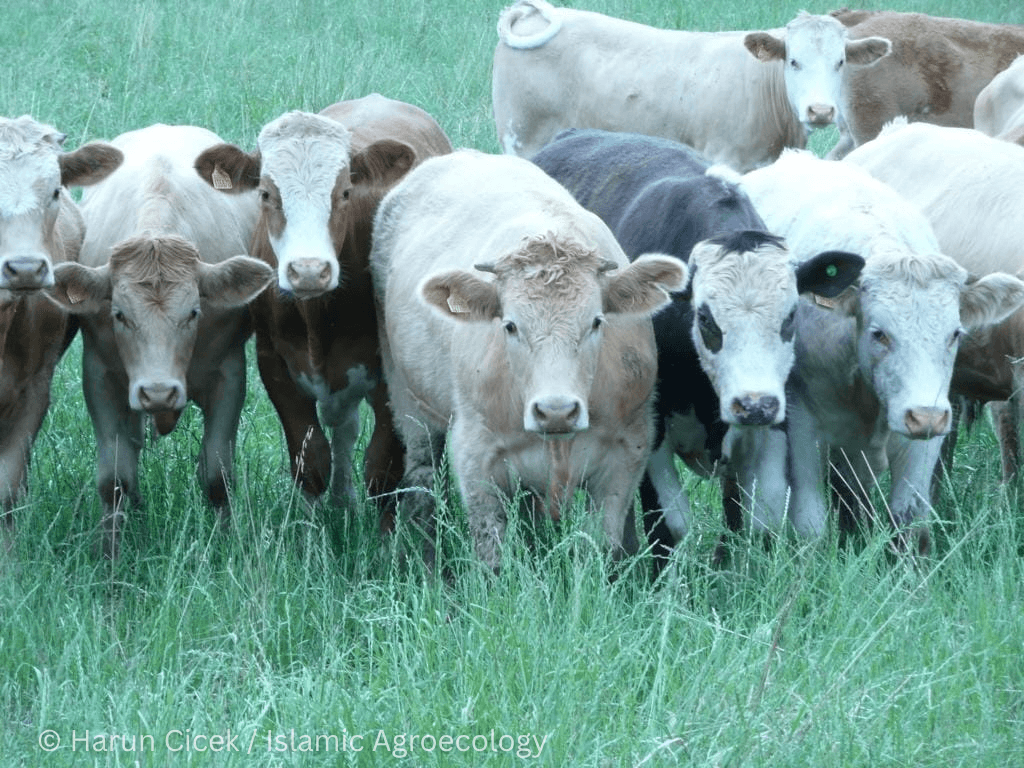
Roughly 97–99% of beef cattle in the US spend the final stretch of their lives in a feedlot, a densely stocked outdoor pen where cattle are fed a corn- and soy-heavy diet to gain weight quickly before slaughter, after spending their first 6–8 months on pasture with their mothers. By 15–22 months, they reach typical slaughter age, versus 20–25 years of natural cattle lifespan.

A cow’s natural diet is grass, which its stomach is built to digest slowly over many hours of grazing. The grain-heavy feedlot diet is what makes rapid weight gain possible, but it’s a mismatch with the animal’s digestive design, and it’s also why cattle need to be closely monitored for digestive illness while on feed. Feedlot pens themselves are typically bare dirt or mud, with no grazing, at high stocking densities, a far cry from “driving the animal gently” that the Sunnah describes.
It’s worth noting this is also, historically, a very recent development. Before the mid-20th century, cattle in North America and Europe typically took 4–5 years or more to reach slaughter weight on forage alone. The 15–22 month timeline is a product of 20th-century selective breeding and grain-finishing, not how cattle were raised for most of human history, including throughout the early Islamic centuries.
Dairy: The Cost Behind the Carton
Milk gets far less scrutiny than meat in most halal conversations, but the welfare picture is arguably just as demanding.
About 75% of US dairy cows are kept in confinement-style (CAFO) operations. Like all mammals, a cow only produces milk after giving birth, so for a continuous milk supply, dairy cows are kept in a repeating cycle of pregnancy and birth. On the vast majority of dairy farms in North America and Europe, the calf is separated from its mother within 24 hours of birth, specifically to preserve the milk for sale rather than for the calf to nurse. Female calves usually become the next generation of milking cows; male calves, unable to produce milk, are typically raised for veal or beef, often sold off the birth farm within weeks.
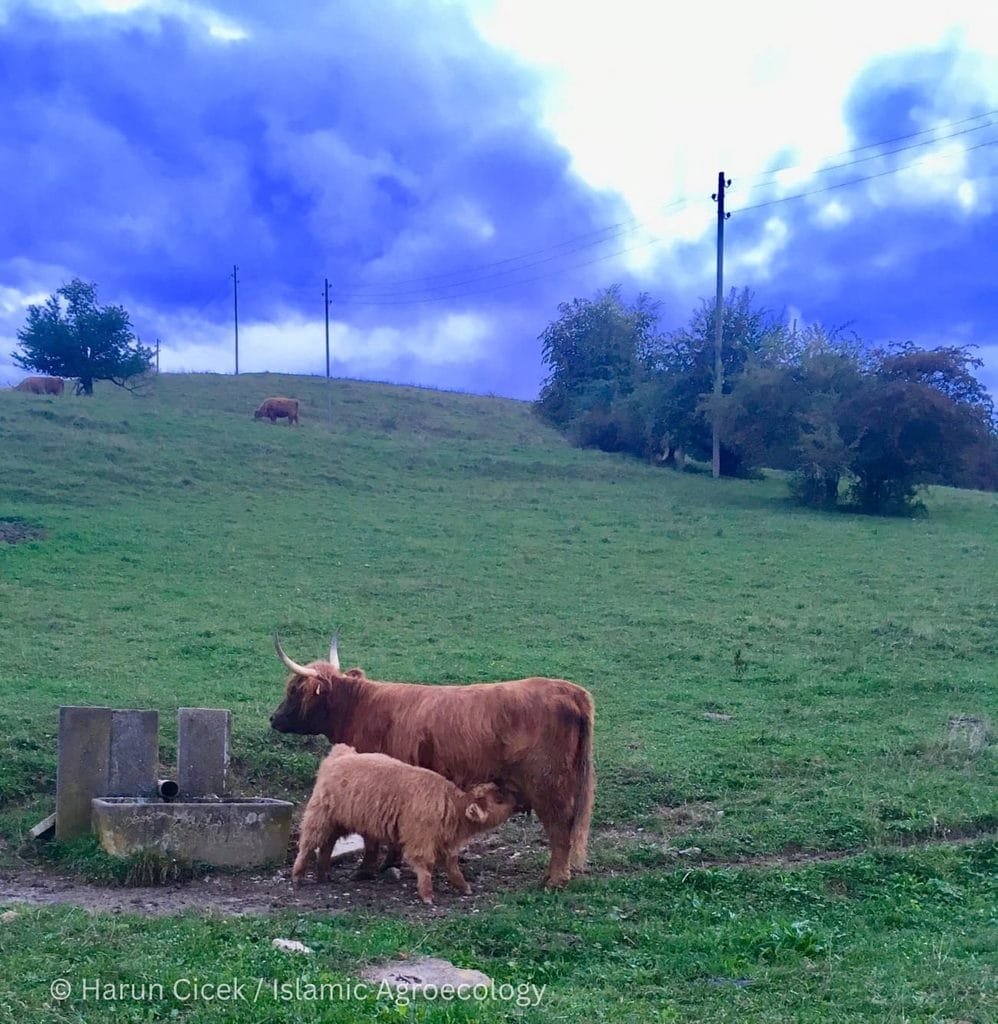
Once a cow’s milk yield drops, commonly after just a few years of the intensive lactation cycle demanded by modern high-yield breeds, she is culled. The average age at slaughter for a dairy cow is 5–6 years, against a natural cattle lifespan of 20 years or more. She spends roughly a quarter of her potential life, almost all of it, in repeated pregnancy and separation from her calves.
Lamb and Mutton: A Different Picture
Lamb is the one meat covered here where the North American and European picture is meaningfully less industrial, though not because of anything special about domestic production.
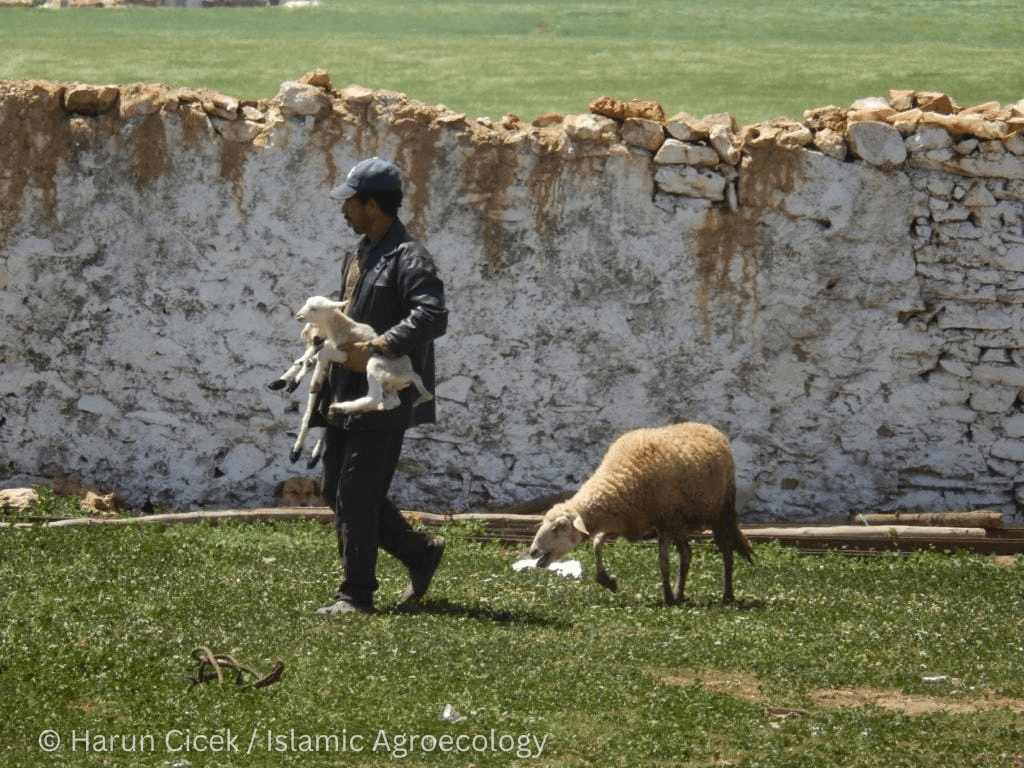
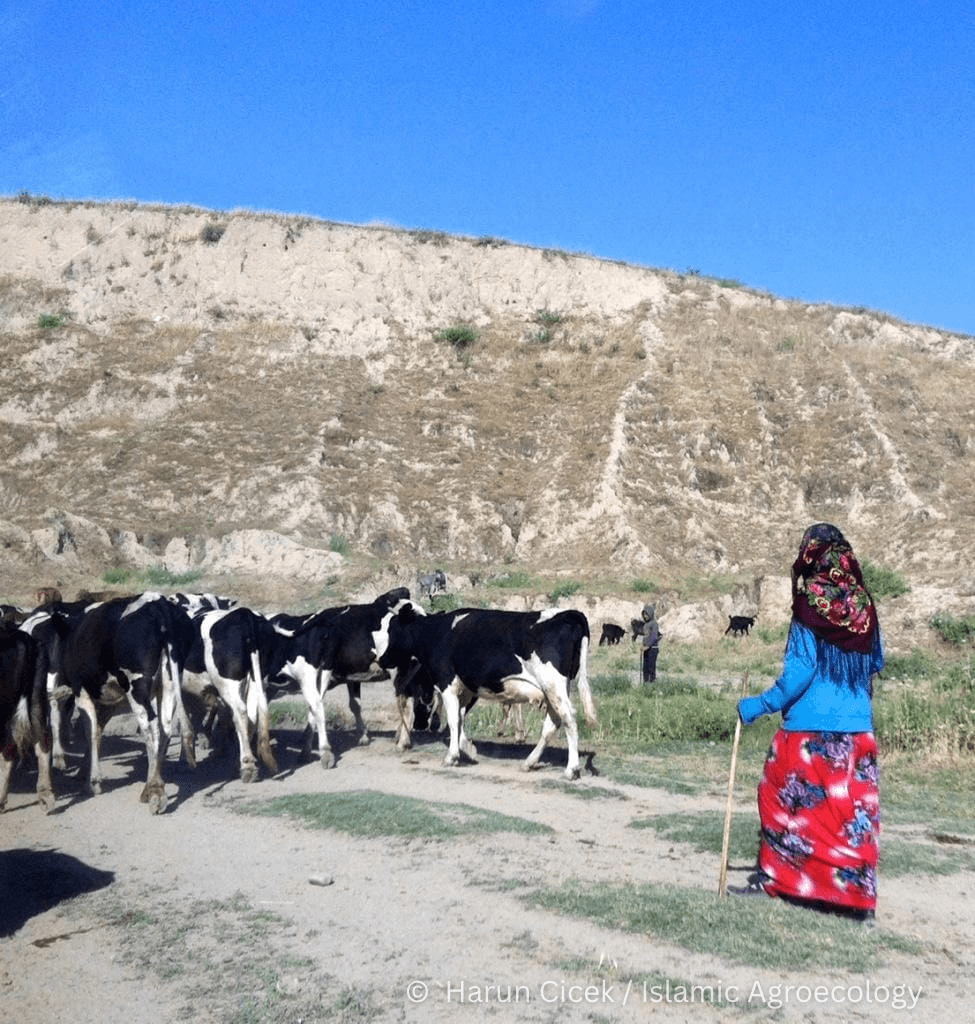
Most lamb actually raised in the US is feedlot-finished, much like beef. But here’s the twist: about 73% of all lamb and mutton eaten in the US is imported, mostly from Australia and New Zealand, where sheep are predominantly raised on open pasture rather than in feedlots. So a lamb chop bought at a US grocery store is, on the numbers, more likely than not to have come from a pasture-based system; this is the one meat where imports genuinely change the welfare picture for the better, in contrast to nearly everything else in this article. Australian and New Zealand “prime lamb” is typically slaughtered at 4–8 months of age, against a natural sheep lifespan of 10–20 years, still a small fraction of a full life, but within a farming system closer to what the Sunnah’s language of grazing, driving gently, and pasture assumes.
The Land, the Fertilizer, and the Air
The Qur’an repeatedly ties tayyib to what comes from the earth itself, and the earth behind feedlot meat is worth understanding.
Feedlot rations are dominated by corn and soybean meal, and most of that grain comes from a narrow band of US states; Iowa, Illinois, Nebraska, Minnesota, and Indiana grow the large majority of the country’s corn and soy. Growing that much grain on that much land requires heavy synthetic nitrogen fertilizer, made from natural gas through an energy-intensive industrial process, and applied at a scale that drives nitrous oxide emissions and nutrient runoff into rivers. Around a third of the US corn crop goes directly to animal feed, and much of the ethanol industry’s byproduct (used as animal feed too) draws on another third, so well over half of the country’s largest crop cycles, one way or another, back into livestock troughs.
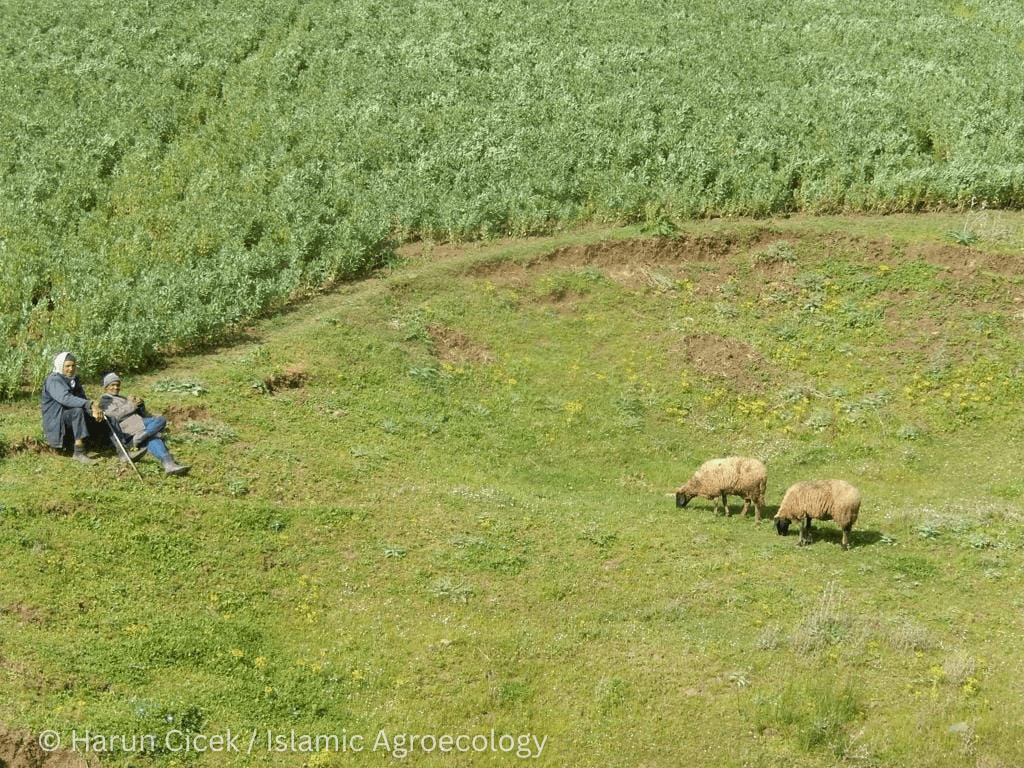
Fertilizer is a bigger share of the footprint for chicken and eggs than for beef and lamb, simply because chickens and laying hens are fed almost entirely on grain, while cattle and sheep get at least part of their diet from grazing. But because cattle and sheep also release methane through digestion, a very potent greenhouse gas, their overall footprint stays far higher despite needing less fertilizer per animal. There’s no single “winner” here in a simple sense: grain-heavy systems lean harder on fertilizer and fossil-fuel inputs; grazing systems use vastly more land and produce more methane per animal. Both leave a mark on the earth the Qur’an asks us to treat with care.
What Ends Up in the Meat
A common assumption among people is that chicken is pumped full of hormones. Thankfully, hormones have been illegal in US poultry production for decades. Antibiotics are the real, more complicated story. Antibiotic use for growth promotion became effectively illegal in the US in 2017. Since then, use has fallen sharply. The bigger, less publicized concern is antibiotic-resistant bacteria carried on meat, not the drug itself, but bacteria that survived exposure to it and can pass resistance on, either by directly causing a harder-to-treat infection or by transferring resistance genes to bacteria already in your gut. This is a real, actively studied public health issue, but proper cooking (165°F/74°C internal temperature for chicken) kills the bacteria regardless of resistance, which is the practical safeguard that matters most at the individual level.
Al-Ghazali on the Stomach
Long before feedlots existed, Imam al-Ghazali (d. 1111 CE) devoted an entire book of his Iḥyāʾ ʿUlūm al-Dīn, the Revival of the Religious Sciences, to exactly this question: what does it mean to eat rightly, and what goes wrong when we don’t?
In Kitāb Ādāb al-Akl (Book XI, “The Manners Relating to Eating”), his very first rule of eating is that food must be lawful both in itself and in how it was acquired. He draws this straight from the Qur’an’s pairing of halal and tayyib. His fifth rule turns to restraint: he argues that overeating obstructs devotion rather than fuels it, citing the Prophetic teaching that no vessel is worse than a full stomach, and that one should stop eating before feeling full, not after.
He returns to this question at far greater length in Kasr al-Shahwatayn (“Breaking the Two Desires,” Book XXIII), where he makes a striking claim: that an unrestrained stomach is the root of a whole chain of moral corruption. Satisfied appetite for food, he argues, feeds desire for sex, which feeds desire for wealth and status, which breeds rivalry and envy, which curdles into arrogance and hatred, which finally erupts into open wrongdoing and injustice. He grounds this in the Qur’anic account of Adam and Eve — the very first human sin, he points out, was an act of the stomach’s appetite. Hunger, deliberately chosen, is what breaks this chain: it softens the heart, curbs pride, and — notably for this article — makes a person mindful of those who go hungry involuntarily.
Al-Ghazali wasn’t writing about factory farms. But his argument lands differently once meat is cheap, available in unlimited quantity, and produced without any friction that might prompt restraint. A large part of what makes today’s intensive animal agriculture possible is precisely that it has removed every natural check on consumption that used to keep meat scarce, seasonal, and effortful to obtain. Al-Ghazali would likely see that as exactly the condition his fifth rule warns against — not a reason to never eat meat, but a reason to eat less of it, more deliberately, and with real awareness of what it cost to produce.
Other Muslims are Asking the Same Questions
This concern isn’t new, and it isn’t fringe. A growing body of Muslim writing has been making versions of this same argument for years, from a range of positions.
One of the earliest and most direct voices was Al-Hafiz Basheer Ahmad Masri, a British Islamic scholar and pioneer of Muslim animal-welfare writing, whose book Animal Welfare in Islam argued that Muslims fully informed about factory farming conditions would, in his view, choose not to eat that meat at all. SeekersGuidance‘s essay “The Ethical Treatment of Animals” makes the halal-plus-tayyib argument in almost the same terms used here, and specifically names industrial animal farming as incompatible with Islamic principles regardless of economic efficiency. Writer Ibrahim Abdul-Matin, author of Green Deen: What Islam Teaches About Protecting the Planet, and groups like Green Muslims and Green Ramadan have pushed a “new halal” reading that folds in mindful eating, humane farming, and environmental awareness under the banner of tayyib. The UK-based Halal Animal Welfare Association goes further still, arguing that meat from animals raised in poor conditions cannot really be called tayyib even when the slaughter itself was correctly performed. On the far end of the spectrum, sites like Green Islam and the Interfaith Vegan Alliance argue that, given the current state of the industry, avoiding animal products altogether is the only way to reliably stay within halal-and-tayyib bounds, while acknowledging, as most of these writers do, that this is a personal conclusion rather than a settled ruling.
You’ll notice these voices don’t all land in the same place. Some call for reform and better sourcing; some call for drastically less meat; some call for none at all. That range is worth knowing about, because it tells you this is a live, serious conversation inside the Muslim community, not something you’re inventing by asking the question.
So What Should You Actually Eat?
This article isn’t going to tell you to become vegetarian, or that any specific label guarantees you’ve fulfilled tayyib. What it can do is give you a way to actually apply vigilance, rather than defaulting to whatever’s cheapest and closest.
- Separate halal-certified from tayyib-minded
A halal-certification sticker tells you about the moment of slaughter. It tells you nothing about the six weeks or five years before that moment. Both questions matter; only one is usually visible on the package.
- Learn to read (and doubt) welfare labels
“Cage-free” removes the cage but not beak trimming or male chick culling. “Grass-fed” doesn’t guarantee “grass-finished” — as of 2024, US labeling rules finally require producers to be explicit about this, so look for “grass-finished” specifically. Third-party certifications like Certified Humane, Animal Welfare Approved, and the American Grassfed Association carry more weight than a producer’s own claims, but they remain a small share of the market and usually cost more.
- Ask your halal butcher the second question
Most halal butchers can tell you about slaughter method. Fewer are asked about how the animal was raised. Asking anyway where the animals came from, whether they were pasture-raised or feedlot-finished, is itself a small act of tayyib-mindedness, and it signals demand that can shift what your local butcher chooses to stock.
- Weigh environment against welfare honestly
Chicken and eggs generally carry a smaller environmental footprint than beef or lamb, but come from more intensive, higher-welfare-cost systems. Grass-based lamb (often imported) and pasture-raised beef generally mean better welfare and lower fertilizer input, but more land and, for beef and lamb, higher methane emissions. There’s no single choice that scores best on every measure, which is exactly why al-Ghazali’s answer wasn’t “choose the right meat”; it was “eat less of it, more deliberately.”
- Let quantity do some of the work
You don’t need a perfect supply chain to apply the Sunnah’s practice of moderation. Treating meat as a smaller, more occasional part of a meal, closer to how it was eaten for most of Islamic history, before feedlots made it cheap and constant, reduces your exposure to nearly every problem raised in this article, regardless of which brand or farm it came from.
- Look for the seams in the system: local, small-scale, direct
A local halal farm, a community-supported agriculture (CSA) share, or a small regional producer you can actually ask questions of will rarely match the price of supermarket meat, but it’s usually the most reliable way to get an honest answer about how an animal actually lived, which is, in the end, the whole point of asking whether something is tayyib.
A Closing Thought
The Qur’an didn’t pair halal with tayyib by accident, and it didn’t leave tayyib undefined by accident either. It left it to conscience, context, and continual questioning, which is exactly what this article is asking you to bring to your next grocery trip. None of this is about guilt. It’s about the same vigilance the Prophet ﷺ showed toward a mother bird’s distress, applied to a food system he never could have imagined.
islamicagroecology.org · This is part one of a two-part series. Part two will look at plant-based foods through the same halal-and-tayyib lens.
References and Further Reading
Hadith are cited to their primary collections (Sahih al-Bukhari, Sahih Muslim, Sunan Abi Dawud, Jami’ al-Tirmidhi, Sunan al-Nasa’i, Sunan al-Bayhaqi). Statistics and industry data below.
- Basheer Ahmad Masri, Animal Welfare in Islam (Islamic Foundation, 2007)
- SeekersGuidance, “The Ethical Treatment of Animals” — seekersguidance.org/articles/the-ethical-treatment-of-animals
- Civil Eats, “Sustainable Halal Meat is Making Inroads in Muslim Communities” — civileats.com, on Green Muslims, Green Ramadan and Ibrahim Abdul-Matin’s Green Deen
- Halal Animal Welfare Association, “Halal and Tayyib: A Definition” — halal-animal-welfare-association.mozellosite.com
- Green Islam, “Is the Halal Food Industry Truly Halal?” and “What Do the Ahadith Say About Animal Rights?” — greenislam.org
- Interfaith Vegan Alliance, “Animal Welfare in Islam” — interfaithveganalliance.org
- EcoMENA, “Animal Welfare: Guiding Principles in Islam” — ecomena.org
- Springer Nature, Discover Sustainability, “Navigating Moral Landscape: Islamic Ethical Choices and Sustainability in Halal Meat Production” (2024)
- Al-Ghazali, Kitāb Ādāb al-Akl, trans. Denys Johnson-Davies (Islamic Texts Society, 2000)
- Al-Ghazali, Kasr al-Shahwatayn, trans. Caesar E. Farah as Abstinence in Islam (Bibliotheca Islamica, 1992); trans. T.J. Winter (Islamic Texts Society, 1995)
- USDA-NASS Cattle on Feed reports; National Chicken Council; Sentience Institute, US Factory Farming Estimates (2024)
- American Sheep Industry Association, lamb and mutton trade data (2025)
- Poore & Nemecek (2018), Science 360(6392), via Our World in Data
- FDA / USPOULTRY joint antibiotic-use reports (2024–2026); USDA FSIS National Residue Program
- Johns Hopkins Center for a Livable Future, roxarsone study, Environmental Health Perspectives (2013)
- RSPCA Knowledgebase; Cow-calf separation research, Applied Animal Behaviour Science